Peak Leaf Peeping: The Best Fall Foliage Lookout Trails Near Miller Lake
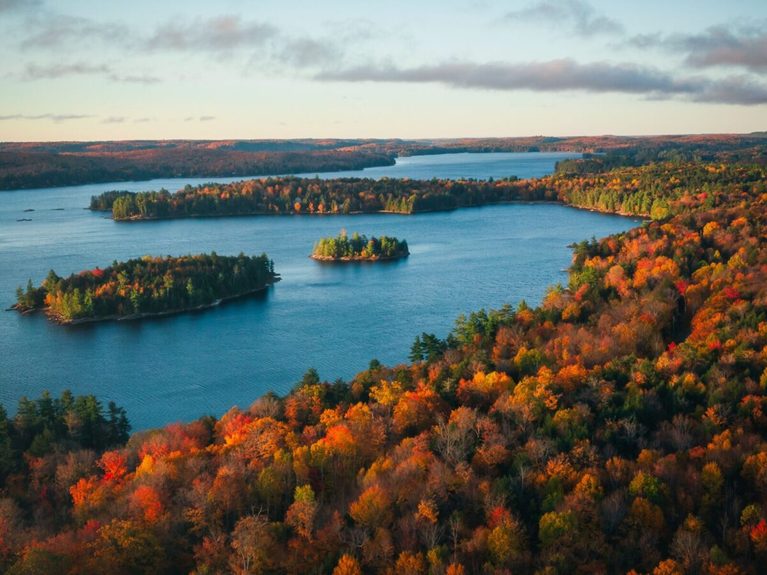
Autumn on the Bruce Peninsula brings a quiet transformation. As summer crowds taper off and crisp breezes roll over Lake Huron and Georgian Bay, the Niagara Escarpment erupts into a vivid display of scarlet, burnt orange, and brilliant gold. Staying centrally at Miller’s Family Camp puts you within easy reach of the most spectacular fall foliage lookout trails near Miller Lake, where ancient sugar maple forests frame white dolomite cliffs and deep blue waters.
Whether you seek rugged, high-elevation cliff hikes along the Bruce Trail or peaceful forest boardwalks, autumn offers the ideal season to explore the northern peninsula. Lower afternoon temperatures make for comfortable trekking, while the seasonal leaf change provides unmatched opportunities for landscape photography and outdoor recreation.
When is Peak Fall Foliage near Miller Lake?
Peak fall foliage near Miller Lake typically occurs between late September and mid-October, reaching maximum color intensity around Thanksgiving weekend. Sheltered inland hardwood forests turn red and gold first, while Niagara Escarpment cliffs along Georgian Bay peak slightly later due to lake temperature regulation, extending the autumn peeping window.
The timing of peak autumn color is driven by shorter daylight hours and cooler overnight temperatures. The northern Bruce Peninsula features a distinct microclimate created by surrounding waters. Inland forests around Miller Lake and the Lindsay Tract consist largely of dense sugar maple, red maple, and yellow birch stands. These sheltered inland trees shift early in the season, blanketing roadways and trailheads in rich crimson and orange hues by late September.
Along the exposed escarpment cliffs, cooler breezes off Georgian Bay moderate early frosts. This creates a staggered leaf change across the region. Soft maples and sumac initiate the color shift in mid-September, followed by peak sugar maple color in early October. By late October, late-season red oaks and golden tamarack needles in wetland areas complete the autumn transition, offering a multi-week window for fall road trips and day hikes.
1. Lion’s Head Lookout Trail: The Escarpment Crown
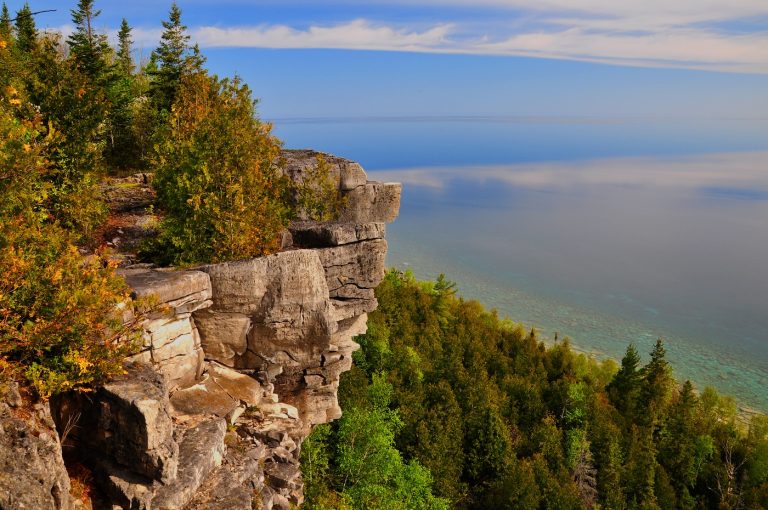
The Lion’s Head Lookout Trail offers the premier fall foliage vista on the Bruce Peninsula, located fifteen minutes south of Miller Lake. Ascending two hundred feet above Georgian Bay along the Niagara Escarpment, this hike delivers sweeping panoramas of blazing red sugar maples framing dramatic limestone cliffs and clear turquoise waters.
- Drive Time from Miller’s Family Camp: 15 minutes (18 km south)
- Trail Distance: 5.2 km round trip (Main Bruce Trail Loop)
- Difficulty Level: Moderate to Strenuous
- Trailhead Location: McCurdy Drive Parkette, Lion’s Head
The trail begins with a gradual incline through mixed hardwood forest, where fallen leaves create a crisp canopy carpet underfoot. As you trek inland along the main white-blazed Bruce Trail, the forest dense with sugar maples, American beech, and basswood gives way to exposed dolomite bedrock. Ancient, twisted eastern white cedars—some over a thousand years old—clinging precariously to the cliff face add deep evergreen accents to the surrounding sea of red and yellow leaves.
Reaching the main lookout projection exposes a breathtaking view. To the south, the cliffline curves past Cape Dundas; to the north, the profile of Lion’s Head formation stands tall over the bay. The contrast between the deep turquoise water of Georgian Bay and the blazing canopy of the forest floor makes this lookout an unforgettable autumn destination.
2026 Parking & Access Guidelines
To manage trail capacity and preserve fragile escarpment ecosystems, municipal parking at the McCurdy Drive Parkette requires mandatory advance reservations through October 31. Reserve your 4-hour parking slot online via the municipal booking platform prior to arrival. If McCurdy Drive slots are filled, designated overflow parking is available at the Lion’s Head Community Centre arena lot, which connects to the main trail via an access route.
Footwear & Safety Recommendations
Navigating the escarpment edge demands careful foot placement. Wet autumn leaves can make smooth dolomite rock and open crevices slick. Wear sturdy, high-traction hiking boots with good ankle support. Because the main lookout cliff drops over two hundred feet without safety railings, maintain a safe distance from the edge, monitor children closely, and keep dogs on a tight leash at all times.
2. Burnt Point Loop & Little Dunks Lookout: Accessible Canopy Views
Burnt Point Loop and Little Dunks Lookout provide an accessible, low-intensity fall hiking option inside Bruce Peninsula National Park, twenty minutes north of Miller Lake. This flat four-kilometer trail winds through mixed cedar and hardwood forests to elevated wooden platforms overlooking deep-blue Georgian Bay waters framed by autumn foliage.
- Drive Time from Miller’s Family Camp: 20 minutes (24 km north)
- Trail Distance: 4.8 km loop
- Difficulty Level: Easy to Moderate
- Trailhead Location: Parks Canada Visitor Centre, Tobermory
Starting right from the Parks Canada Visitor Centre in Tobermory, this trail is ideal for families, casual walkers, and senior hikers seeking sweeping autumn views without steep escarpment climbs. Before setting out on the loop, ascend the 20-meter timber observation tower at the Visitor Centre for a panoramic 360-degree view across the forest canopy extending toward Fathom Five National Marine Park.
The trail heads east along packed dirt paths, low wooden boardwalks, and flat limestone slabs. The forest composition here shifts between damp cedar wetlands and sunlit hardwood groves. Yellow birches and trembling aspens produce a brilliant golden canopy overhead, while red maples add pops of bright scarlet along the shoreline paths.
Shoreline Lookouts & Trail Highlights
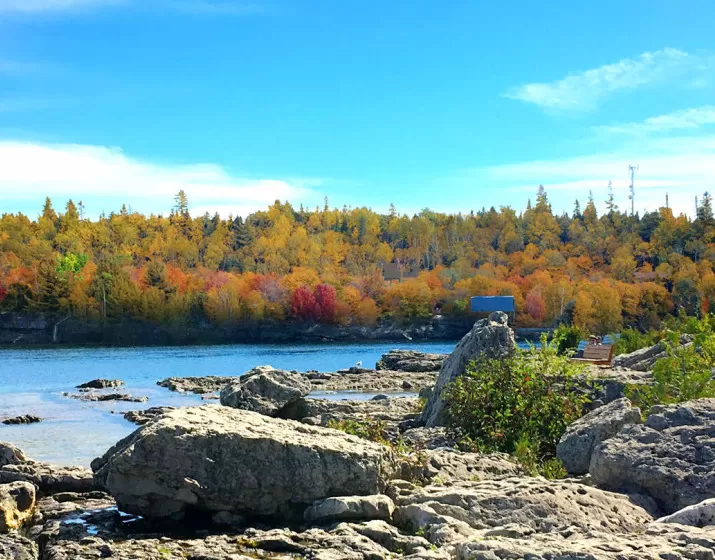
The trail culminates at Little Dunks Bay and Burnt Point, where built-in timber viewing platforms extend toward the water. From these spots, look out across the rocky bay toward coastal islands framed by golden shoreline woods. The flat terrain and smooth surface paths make this one of the most comfortable trails for autumn hiking on the northern peninsula.
| Trail Parameter | Specifications & Details |
| Boardwalk Infrastructure | Level wooden boardwalks covering sensitive wetland zones |
| Surface Conditions | Packed soil, exposed tree roots, flat limestone bedrock |
| Crowd Density | Moderate (Significantly quieter than Cyprus Lake trails) |
| Pet Suitability | Excellent for dogs on leash and family groups |
3. Skinner’s Bluff Lookout Trail: Southern Escarpment Panorama
Skinner’s Bluff Lookout Trail delivers elevated fall canopy views over Colpoy’s Bay and shoreline islands, located forty minutes south of Miller Lake near Wiarton. Featuring dramatic overhanging dolomite cliff edges without heavy tourist crowds, this rocky Bruce Trail section provides sweeping vistas of vivid amber and scarlet hardwood forests.
- Drive Time from Miller’s Family Camp: 38 minutes (45 km south)
- Trail Distance: 6.0 km out-and-back
- Difficulty Level: Moderate
- Trailhead Location: Colpoy’s Mountain Road / Grey Road 1
Positioned along the eastern edge of the peninsula, Skinner’s Bluff remains one of the area’s best-kept secrets. The trail follows an elevated ridge line high above agricultural valleys and coastal waters. As you walk through dense maple and ironwood groves, light filters through yellow and orange leaves, creating a warm glow across the forest floor.
The main lookout point consists of a massive limestone ledge extending out over the valley floor. Standing on the bluff, you look down upon a patchwork of rolling farm fields, dense hardwood forests, and the deep blue waters of Colpoy’s Bay, with White Cloud and Hay Islands resting on the horizon.
Navigation & Trail Notes
Follow the painted white rectangular blazes marking the main Bruce Trail. Side trails are marked with blue blazes. This section features uneven terrain, exposed tree roots, and loose rock. Trekking poles are highly recommended to aid stability on short, steep slopes covered in damp fallen leaves.
4. Halfway Log Dump to Cave Point: Rugged Escarpment Heights
Halfway Log Dump to Cave Point offers a challenging, technical autumn hike along the Bruce Trail, located twenty-five minutes from Miller Lake. Navigating rugged dolomite boulders and ancient cedar ridges, this trail rewards experienced hikers with high-elevation lookout points where burning red maples meet white cliffs and deep blue bay waters.
- Drive Time from Miller’s Family Camp: 25 minutes (28 km northeast)
- Trail Distance: 7.5 km out-and-back (to Cave Point lookout)
- Difficulty Level: Strenuous / Technical
- Trailhead Location: Halfway Log Dump Parking Area, Bruce Peninsula National Park
This trail is designed for experienced hikers seeking a rugged wilderness trek. Beginning with a short, flat 1-kilometer path to a white cobble beach on Georgian Bay, the route turns sharply upward onto the main Bruce Trail, climbing steep, rocky switchbacks to reach the top of the escarpment wall.
Once atop the cliff ridge, the trail leads toward Cave Point, one of the highest and most dramatic elevation points in Bruce Peninsula National Park. From this elevated ledge, the forest stretches out endlessly below. The vivid reds of sugar maples and purples of white ash trees contrast sharply with the white limestone cliff faces and the deep turquoise waters of Georgian Bay.
Essential Gear & Preparation Checklist
- Footwear: Ankle-high, waterproof hiking boots with aggressive lugged soles.
- Hydration: Minimum of 2.5 liters of water per person (no potable water on trail).
- Navigation: Offline mapping app or physical trail map (cellular service is spotty).
- Apparel: Breathable synthetic layers, windproof shell, and cold-weather hat.
- Reservations: Daily parking permits must be booked in advance via Parks Canada.
5. Devil’s Monument Trail: Dyer’s Bay Shoreline Descent
Devil’s Monument Trail presents a quiet, lesser-known fall foliage lookout experience near Dyer’s Bay, just fifteen minutes east of Miller Lake. Hikers descend a steel staircase along the Niagara Escarpment through dense birch and sugar maple stands to reach a historic 44-foot flowerpot rock stack surrounded by fiery autumn colors.
- Drive Time from Miller’s Family Camp: 15 minutes (16 km east)
- Trail Distance: 4.2 km out-and-back
- Difficulty Level: Moderate
- Trailhead Location: Dyer’s Bay Road parking area
Located on the quiet eastern shoreline of the peninsula, Devil’s Monument combines cliffside woodland hiking with unique geological features. The trail leads hikers along the upper rim of the escarpment before making a scenic descent toward the shores of Georgian Bay.
As you walk along the upper ridge, the trail passes through hardwood stands dominated by large sugar maples, paper birches, and beech trees. In early October, falling leaves carpet the limestone path in brilliant shades of yellow and red. A sturdy steel staircase enables a safe descent down the steep cliff face, offering close-up views of rock formations and vibrant foliage hanging from the escarpment wall.
The Flowerpot Rock Formation
At the base of the staircase stands Devil’s Monument, an impressive 44-foot sea stack carved by glacial meltwater thousands of years ago. Standing at the shoreline looking back up, you get a unique low-angle perspective of the towering escarpment cliff face covered in blazing autumn trees.
Essential 2026 Autumn Leaf Peeping Logistics
Planning fall foliage lookout trails near Miller Lake in 2026 requires advance reservations for key trailheads, appropriate cold-weather layering, and proper footwear for wet limestone. Booking municipal parking slots at Lion’s Head and national park spaces at Cyprus Lake ensures smooth access during peak leaf season.
1. Advanced Parking Reservations
- Lion’s Head Lookout: Mandatory parking reservations remain active through October 31 via the HonkMobile booking platform. Secure your 4-hour slot at least 48 hours prior to your hike, especially for weekend visits.
- Bruce Peninsula National Park: Reservation requirements for Halfway Log Dump and Cyprus Lake remain enforced through late autumn. Book time slots online through the Parks Canada Reservation Service.
2. Weather & Layering Strategy
Fall weather on the Bruce Peninsula can shift rapidly. Ambient air temperatures along exposed escarpment cliffs are often several degrees cooler than sheltered inland woods around Miller Lake, with strong winds coming off Georgian Bay.
- Base Layer: Synthetic or merino wool tops to pull moisture away from your skin.
- Insulation Layer: Warm fleece or packable down jacket for rest stops at lookouts.
- Outer Shell: Lightweight, windproof, and waterproof jacket to block bay gusts.
- Footwear: Deep-tread hiking boots. Avoid smooth running shoes on damp limestone.
3. Trail Safety & Wildlife Precautions
Autumn leaf cover can hide loose rocks, tree roots, and deep crevices along escarpment paths. Stay on marked trails and keep clear of cliff edges. Black-legged ticks remain active in fallen leaf litter through late autumn; wear light-colored pants tucked into wool socks and perform a thorough tick check after every outing.
Basecamp Your Autumn Adventure at Miller’s Family Camp
Experiencing the best fall foliage lookout trails near Miller Lake requires a comfortable, centrally located basecamp. Miller’s Family Camp sits right in the heart of the northern Bruce Peninsula, providing easy access to trailhead lookouts from Lion’s Head to Tobermory while offering a quiet retreat away from heavy weekend traffic.
Family-owned and operated since 1967, our camp offers peaceful waterfront cottages and treed campsites along the calm shores of Miller Lake. After a day spent trekking the high cliffs of the Bruce Trail, return to warm up by a crackling campfire, take a peaceful evening paddle on the lake, or simply relax under clear, starlit autumn skies.
Plan your fall leaf peeping trip today to experience the incredible colors, crisp air, and natural beauty of the Bruce Peninsula in autumn.