The Ancient Escarpment: A Guide to Finding Fossils and Unique Rocks Around Miller Lake

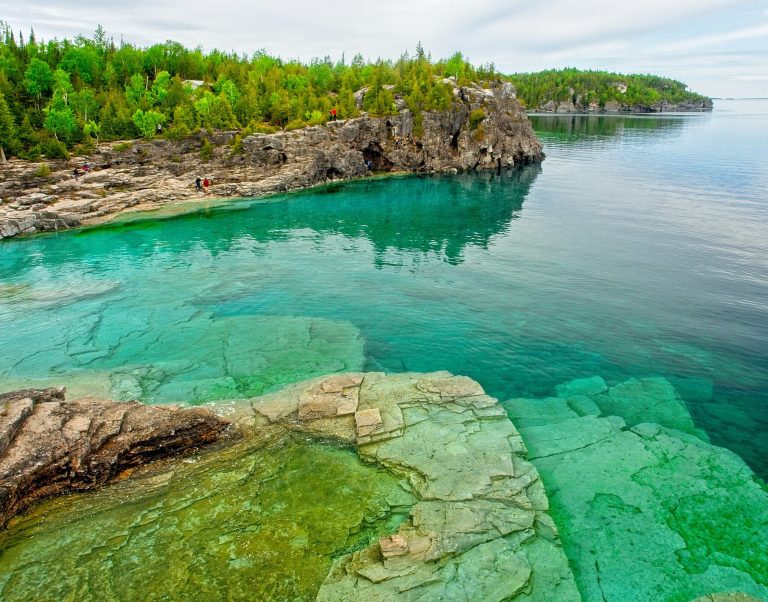
If you have ever stood on the edge of the docks here at Miller’s Family Camp early in the morning, you know there is a quiet magic to this place. The mist slowly lifts off the warm water of Miller Lake, the loons start up their morning calls, and the cedar trees along the shoreline smell crisp and clean. To most of our guests, the Bruce Peninsula feels like a perfect summer paradise, famous for its towering white cliffs and water so brilliantly turquoise you would swear you were in the Caribbean. But if you take a moment to look down right at the stones beneath your running shoes or hiking boots, you will find an entirely different world. You are standing on the edge of an ancient history that goes back hundreds of millions of years.
Here at the camp, our family has been guiding guests through these woods and along these shores since 1967. Over three generations of watching families explore the peninsula, we have noticed that the visitors who have the most unforgettable trips are the ones who pause to look a little closer at the landscape. The Niagara Escarpment isn’t just a beautiful backdrop for a family photo; it is a giant, open-air history book. Every single rock tells a story of tropical seas, colossal ice sheets, and deep time. Whether you are a curious rockhound, a family looking for a fun trail activity with the kids, or just someone who loves a great walk in the woods, this guide is your local roadmap to uncovering the prehistoric secrets waiting just outside your cottage door.
The Secret of the Escarpment: When Ontario Was a Tropical Paradise
To truly appreciate the rocks you find around Miller Lake, we have to travel back about 400 million years to a time called the Silurian period. It is hard to imagine when you are packing a sweater for a cool Bruce Peninsula evening, but back then, this entire region was located right near the equator. Instead of dense cedar forests and deep snow, Ontario was completely submerged under a warm, shallow tropical sea, teeming with prehistoric marine life.
The massive cliffs that give our peninsula its rugged character were built by billions of tiny sea creatures. Generation after generation of ancient corals, shelled organisms, and microscopic plants lived and died in this warm basin. As they died, their calcium-rich skeletons settled to the ocean floor, forming thick layers of lime mud. Over millions of years, the crushing weight of new layers turned that mud into limestone. Eventually, magnesium washed through the water and transformed that limestone into a much tougher rock called dolostone.
This dolostone caprock is the secret to why the Niagara Escarpment exists today. While the softer surrounding rocks were slowly eaten away by water and weather over countless millennia, the resilient dolostone stood its ground. When the great glaciers of the last ice age swept across Canada, they scraped over this hard ridge, carving out deep basins like Georgian Bay, Lake Huron, and our own beautiful Miller Lake. As the ice finally melted away around 11,000 years ago, it left the bare backbone of the escarpment exposed, completely packed with the fossilized remains of that ancient tropical sea.
Spotting the Prehistoric Inhabitants: Common Fossils Around the Lake
When you go out exploring, you do not need a geologist’s hammer or fancy equipment to find fossils. In fact, on the Bruce Peninsula, you legally cannot use tools to extract them, which we will talk about in a moment. All you really need is a keen eye and a bit of patience. The best place to start looking is on flat, grey rock shelves that have been worn down and polished by the wind, water, or the footsteps of other hikers.
One of the most thrilling things for kids and adults alike to discover is honeycomb coral, scientifically known as Favosites. When you find a piece of this native stone along the beach, it looks exactly like a petrified bee colony. You will see a tight network of tiny, hexagonal tubes etched perfectly into the rock. These were the individual chambers where tiny coral organisms lived hundreds of millions of years ago, filtering food from the warm ocean currents.
Another common treasure underfoot is chain coral, or Halysites. If you look closely at a weathered boulder, you might spot lines of tiny vertical loops that look precisely like a delicate silver chain pressed into the stone. It is incredibly humbling to run your fingers over those patterns and realize you are touching a creature that thrived long before the first dinosaur ever walked the earth.
As you wander the shorelines or trail paths, you will also come across small, circular rock discs with tiny holes right through the middle, often stacked together like a tiny roll of coins. These are crinoid stems, often called sea lilies. Even though they look exactly like beautifully carved plant stems or stone beads, crinoids were actually marine animals related to modern starfish. They anchored themselves to the ancient reef with long, flexible stalks. Over time, the stalks broke apart, and their segmented rings became scattered throughout the bedrock. Local folklore across Ontario historically called these detached little rings fairy stones.
You are also highly likely to spot brachiopods, which look remarkably like modern seashells or clams. Their fan-shaped, ridged shells stand out beautifully against the fine-grained grey dolostone. Sometimes you will find an entire rock shelf that is just a solid mass of fossilized shells, showing you exactly what a square foot of the ancient ocean floor looked like eons ago.
Native Bedrock versus Glacial Travelers
When you are beachcombing around The Bruce Peninsula, you will quickly notice that not all the rocks are the same shade of escarpment grey. The local bedrock underfoot is Amabel Dolostone, which has a distinct rough texture and light grey to buff coloring. Sometimes, if you look inside the small pockets or hollows in this rock, you can catch a glimpse of tiny, glittering calcite crystals catching the morning sun.
But scattered right alongside our native grey stone are smooth, colorful boulders that seem completely out of place. You will find brilliant pink granites, deep green stones, and milk-white quartzites. These are what geologists call glacial erratics, and they are the ultimate travelers. During the last ice age, massive continental ice sheets advanced from the far north, carving up the Canadian Shield. The ice plucked up these incredibly hard igneous and metamorphic rocks from hundreds of kilometers away and carried them along like hitchhikers.
When the climate warmed and the glaciers finally melted, they gently dropped these northern boulders right onto our local sedimentary rock plains. Finding a perfectly smooth, pink granite boulder resting on a jagged ledge of grey dolostone is a beautiful visual reminder of the staggering power of the ice sheets that sculpted the peninsula.
For many dedicated rockhounds, the holy grail of beachcombing is St. Joseph Island Puddingstone, a striking quartz conglomerate. This rare rock features a creamy white quartzite matrix packed full of smooth, rounded pebbles of brilliant red jasper, dark chert, and translucent quartz. The contrast looks exactly like a slice of old-fashioned fruitcake or holiday pudding. While these stones are native to the areas way up north near St. Joseph Island, small chunks were carried south by the ice and can occasionally be found washed up on our beaches or nestled along the peninsula trails.
Our Favorite Local Geological Trails Just Minutes Away
If you want to head out on a geological adventure, you do not have to drive far from the camp. We are centrally located right in the middle of the peninsula, which means you can get to some of the most spectacular rock formations and trail loops in less than fifteen minutes.
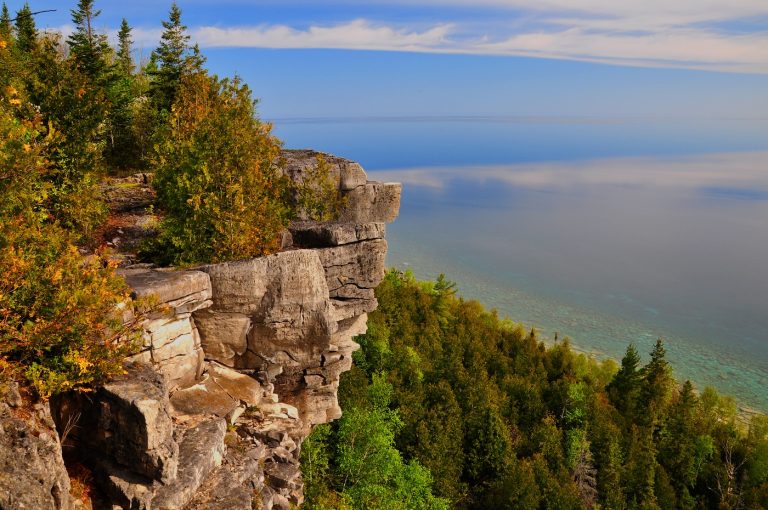
The Cliffs of Lion’s Head Provincial Nature Reserve Located just a short fifteen-minute drive southeast of Miller’s Family Camp, Lion’s Head offers some of the most breathtaking vertical views of the escarpment layers anywhere in Canada. While the famous lookouts give you a 200-foot sheer drop over the turquoise water of Georgian Bay, the trail itself is a paradise for fossil finders. Because thousands of hikers walk this loop every season, their boots have naturally polished the flat rock sections of the path. If you look down as you walk through the shade of the old cedars, you will see massive cross-sections of ancient coral reefs exposed right in the trail floor. It is an easy, beautiful day trip that gets you back to your campsite just in time for an evening swim.
The Lindsay Tract Trails If you are looking for a peaceful, shaded forest walk that is perfect for families, the Lindsay Tract is located just ten minutes south of our front enterance. This is the largest continuous block of forest on the peninsula, and its wide, multi-use paths are built over ancient glacial gravel beds. Because the stone fragments here have been heavily weathered by the elements over thousands of years, the fossils are often partially freed from the surrounding rock matrix. This makes them incredibly easy for children to spot and identify as you stroll beneath the canopy.
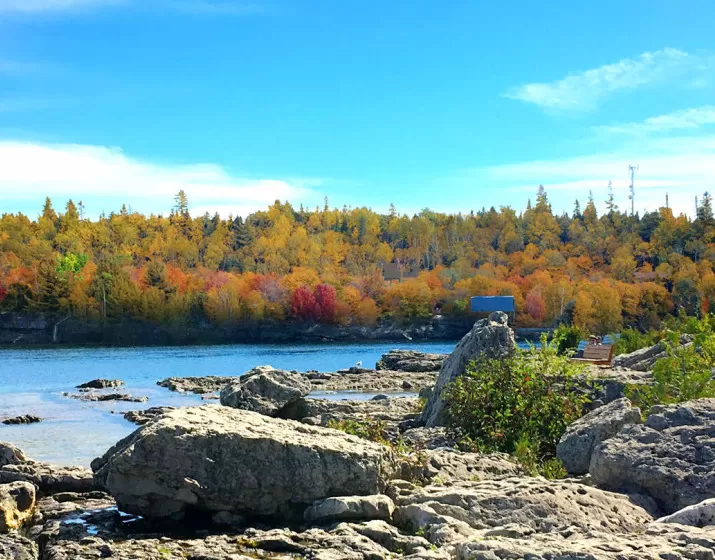
The Little Cove Shoreline If you want to head towards Tobermory, a twenty-minute drive north brings you to Little Cove. Unlike the sandy beaches of the south, Little Cove is a rugged, dramatic shingle beach made up of millions of smooth, water-rounded limestone cobbles. As the powerful waves of Georgian Bay constantly tumble and roll these stones against each other, they continuously expose new surfaces. Walking along the upper tiers of the beach is one of the most rewarding ways to find unique water-polished rocks and beautiful fossil imprints shaped by the lake.
Preserving the Magic: The Ethics of Local Rockhounding
Because we have called this beautiful place home for over fifty years, we always like to share a gentle reminder about the unique rules of the Bruce Peninsula. This entire region is a deeply protected and delicate ecological framework, designated as a UNESCO World Biosphere Reserve. Because of this, a strict “look but don’t take” policy is in place across all of our National Parks, Provincial Nature Reserves, and local conservation lands.
Removing fossils, stones, or minerals from these protected zones is illegal and can result in heavy fines. More importantly, when rocks are taken or fossils are chiseled out of the bedrock, it destroys critical habitats for rare plants, speeds up shoreline erosion, and takes away the magic for the next family walking down the trail. We always tell our campers that a fossil looks infinitely more beautiful embedded in the ancient cliffside where it has rested for 400 million years than it does sitting on a bedroom shelf at home.
Instead of collecting physical stones, we love encouraging creative, non-destructive ways to preserve your discoveries:
Take Digital Photographs: The cameras on modern smartphones are incredible. If you splash a little bit of water onto a fossilized coral to bring out the contrast and use the macro setting, you can capture breathtaking, crystal-clear textures that make for an incredible digital collection.
Keep a Field Journal: Bring a small notebook on your hikes. Kids love sketching the different patterns they find, noting the date, the trail name, and trying to identify if they found a honeycomb coral, a chain coral, or a crinoid stem.
Create Pencil Rubbings: For fossils with raised textures, place a clean sheet of paper flat over the stone and gently brush a soft pencil or crayon across it. You will create a beautiful, artistic print of a prehistoric sea creature that you can frame and take home.
Your Prehistoric Journey Begins at the Docks
At the end of a long day spent exploring the ancient cliffs and tracking down ancient secrets along the trails, there is nothing quite like coming back home to the quiet shores of Miller Lake. Our central location means you spend less time driving around and more time enjoying the actual spirit of the peninsula.
Whether you are staying in one of our cozy waterfront cottages or setting up camp under our mature trees, you are living right alongside the very history you are exploring. Wash the trail dust off your boots, fire up the campfire to roast some marshmallows under our spectacular dark skies, and listen to the same wind that has been shaping these limestone cliffs for millennia.
Our family has been helping travelers make lakeside memories here since 1967, and we are always happy to share our favorite trail maps and local updates when you check into the office. Arran and Lindsay carry that torch today, personally managing every corner of the grounds to ensure your family enjoys an authentic, welcoming wilderness escape. The ancient escarpment is waiting just outside your door. Plan your stay with us and start your own journey into deep time this season!